
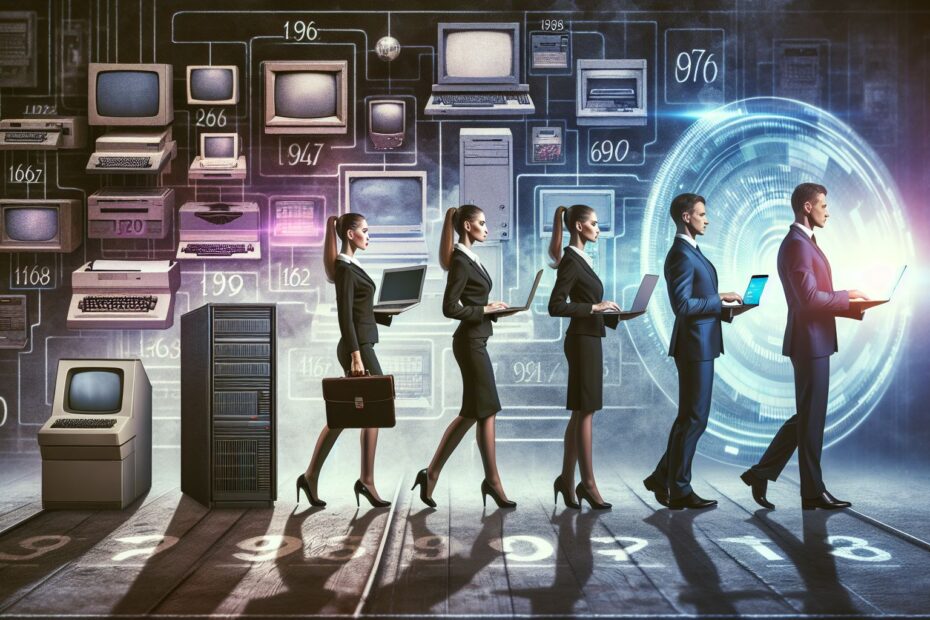
In today’s digital age, computers have become an integral part of our personal and professional lives. From the mighty machines occupying large rooms to the sleek laptops sitting on our desks, the evolution of computers has been nothing short of extraordinary. In this article, we will take a journey through time, exploring the fascinating history and advancements of computers. So grab your cup of coffee and prepare to be amazed!
The Birth of Computers: From Eniac to Mainframes
It all began with the Electronic Numerical Integrator and Computer (ENIAC). Developed during World War II, this colossal machine was the first general-purpose digital computer. Occupying an entire room, it consisted of thousands of vacuum tubes and consumed an enormous amount of electricity. Although slow and cumbersome by today’s standards, the ENIAC paved the way for the development of mainframe computers.
Mainframes, which dominated the computing landscape during the 1950s and 1960s, were incredibly powerful machines. They were primarily used by large organizations and government agencies for complex calculations and data processing. These monolithic structures provided the groundwork for various computing concepts that are still relevant today, such as time-sharing and multiprocessing.
The Rise of Personal Computers: An Era of Accessibility
The 1970s witnessed the birth of personal computers (PCs), marking a revolutionary shift in the computing world. Companies like Apple and IBM brought computers into the homes and offices of ordinary individuals. PCs offered unparalleled flexibility and convenience, empowering users to take control of their computing experience.
With the introduction of the graphical user interface (GUI) in the 1980s, PCs became even more user-friendly. The iconic mouse and desktop metaphor transformed the way people interacted with computers, making them accessible even to those with limited technical expertise.
The Internet Age: Connecting the World
As the 1990s approached, the advent of the internet brought about a new era of connectivity. The World Wide Web, invented by Sir Tim Berners-Lee, allowed computers to communicate and share information on a global scale. Email revolutionized communication, and the birth of search engines made information accessible like never before.
The internet also marked the beginning of a new breed of computers: laptops. These portable machines gave professionals the freedom to work from anywhere, untethered from their desks. With each passing year, laptops became faster, lighter, and more powerful, setting the stage for the mobile revolution.
The Age of the Smartphone: Computing in Your Pocket
In 2007, the world changed forever with the introduction of the iPhone. This groundbreaking device brought the power of a computer to the palm of our hands. Combining the functionalities of a phone, computer, and camera, smartphones rapidly became a vital tool for both personal and professional use.
The advent of smartphones gave birth to a multitude of mobile applications (apps). From productivity tools to social media platforms, apps allowed us to accomplish tasks more efficiently and connect with others effortlessly. Moreover, cloud computing emerged as a powerful concept, enabling us to store our data remotely and access it from any device.
The Future of Computing: From Artificial Intelligence to Quantum Computing
Looking ahead, the future of computing is filled with exciting possibilities. Artificial intelligence (AI) has the potential to transform countless industries, as machines become increasingly capable of learning and making decisions. From chatbots to self-driving cars, AI is already making waves, and its impact is set to continue growing.
Another area of advancement is quantum computing. Unlike traditional computers that use bits to store information, quantum computers leverage quantum bits (qubits), allowing for unprecedented computing power and speed. While still in its infancy, quantum computing holds immense promise for solving complex problems that are beyond the reach of classical computers.
Conclusion
Computers have come a long way since their inception. From filling entire rooms to fitting in our pockets, they have been instrumental in shaping our world and enhancing our productivity. As a modern business professional, understanding the evolution of computers can give you valuable insights into the rapidly changing technological landscape.
So, the next time you fire up your laptop or unlock your smartphone, take a moment to appreciate the incredible journey that computers have taken. From the ENIAC to the age of quantum computing, these machines continue to change our lives in ways we couldn’t have imagined just a few decades ago. Embrace the evolving world of computers and be ready to embrace the possibilities it will bring in the years to come.