
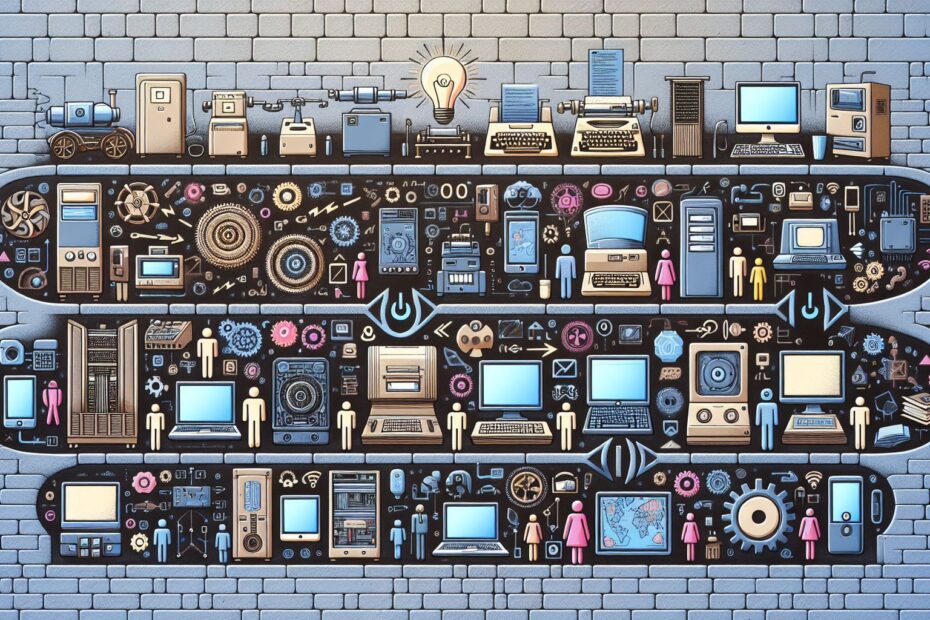
Computers have become an integral part of our lives, revolutionizing the way we work, communicate, and access information. From the bulky mainframes of the past to the sleek laptops and smartphones of today, the journey of computers has been nothing short of extraordinary. In this article, we will explore the evolution of computers and how they have transformed the business landscape, empowering individuals and organizations alike.
The Dawn of Computers
The story begins in the early 1940s when the first electronic computers were developed. These mammoth machines, occupying entire rooms, were nothing like the portable devices we are accustomed to today. However, they laid the groundwork for the digital revolution that was to come.
One notable computer in this era was the Enigma machine, developed during World War II. Used by the Germans to encrypt and decrypt secret messages, the machine was a cryptography marvel of its time. The cracking of Enigma’s code by British mathematicians at Bletchley Park is considered a turning point in history – a triumph of human intellect and the first step towards the computer-aided future.
The Birth of Personal Computers
The advent of personal computers in the 1970s marked a significant milestone in computer history. These compact machines, such as the iconic Commodore PET and Apple II, brought computing power within the reach of individuals and small businesses. Suddenly, tasks that once seemed inconceivable were now achievable from the comfort of one’s own desk.
The 1980s witnessed a boom in personal computer sales, with IBM leading the charge. The introduction of the IBM PC brought credibility and standardization to the market, sparking a wave of innovation and competition. Word processing, spreadsheets, and databases became accessible to a broader audience, forever changing the way businesses operated.
The Internet Age
The true transformational power of computers was unleashed with the advent of the internet. As the world became increasingly interconnected, computers evolved from standalone devices into gateways to a vast digital universe. The World Wide Web, created in 1989 by Sir Tim Berners-Lee, opened up new frontiers for business, communication, and information sharing.
The internet revolutionized industries as diverse as retail, finance, and entertainment. E-commerce emerged as a new way of doing business, allowing companies to reach global markets with unprecedented ease. The once impossible task of exchanging information across continents became a matter of a few mouse clicks, empowering businesses and individuals to collaborate and thrive on a global scale.
Computers as Tools for Business
In the present day, it is almost impossible to imagine running a business without computers. From small startups to multinational corporations, computers have become essential tools for increasing productivity, streamlining operations, and gaining a competitive edge.
The modern workplace is characterized by computers that are faster, more powerful, and more connected than ever before. Tasks that used to take hours can now be completed in minutes. Complex data analysis, intricate financial modeling, and immersive virtual presentations are all made possible by the continuous advancements in computer technology.
The Rise of Artificial Intelligence
As computers have continued to evolve, so too have the possibilities they offer. Artificial Intelligence (AI), once a concept confined to the realm of science fiction, is now becoming a reality. AI-enabled systems can analyze massive amounts of data, identify patterns, and make predictions with astonishing accuracy. From chatbots that provide customer support to self-driving cars, AI is transforming various industries, revolutionizing the way we work and live.
The Future of Computing
Looking ahead, the future of computers promises even more astonishing developments. Quantum computing, with its ability to solve complex problems exponentially faster than classical computers, holds immense potential for various industries, including pharmaceuticals, logistics, and cryptography.
Other exciting areas poised for advancement include augmented reality, virtual reality, and the Internet of Things (IoT). These technologies have the power to reshape industries and create new business opportunities. Imagine surgeons performing complex operations remotely through virtual reality or factories optimizing production through interconnected sensors. The possibilities are limited only by our imagination.
In conclusion, computers have come a long way since their early days of monstrous machines and secret code-cracking. Today, they are engines of empowerment, driving innovation and transforming businesses across the globe. From personal computers to the internet revolution and the rise of artificial intelligence, the evolution of computers has been nothing short of remarkable. As we march towards an exciting future, it is crucial to embrace these advancements and harness the immense potential they offer. After all, computers are not just devices; they are the bridges that connect us to a world of unlimited possibilities.